Making sure your New Year resolutions aren’t a flop
Making sure your New Year resolutions aren’t a flop
We are approaching a time of year when people often make New Year’s resolutions. According to Dr. Cliff Arnall from the University of Cardiff the most depressing day of the year is the last Monday in January. This is due to a number of reasons, some of which includes:
- The weather is usually pretty lousy.
- People have normally received their credit card bill for the period that covers Christmas spending, and,
- New Year’s resolutions have normally been broken.
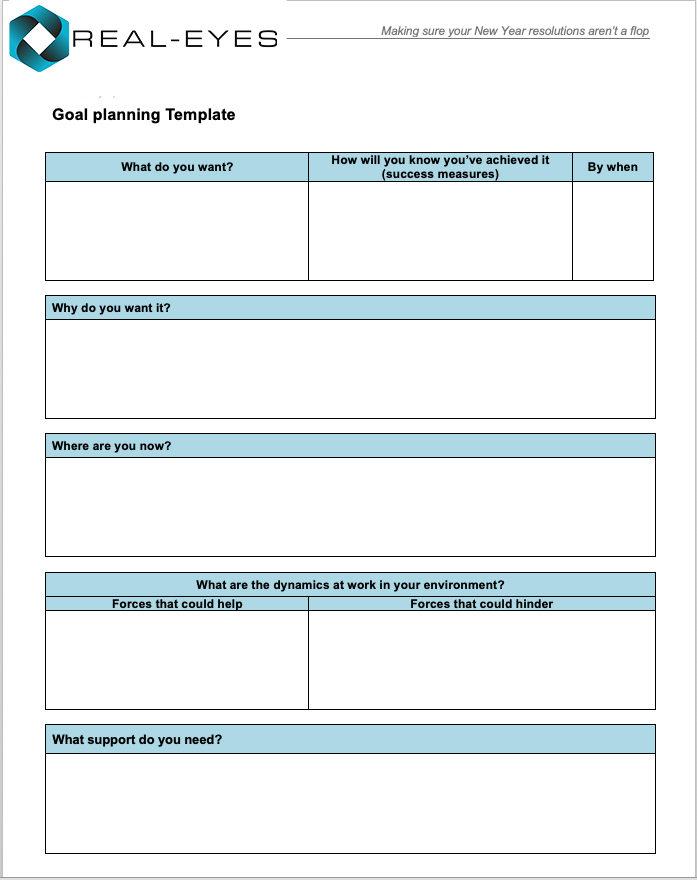
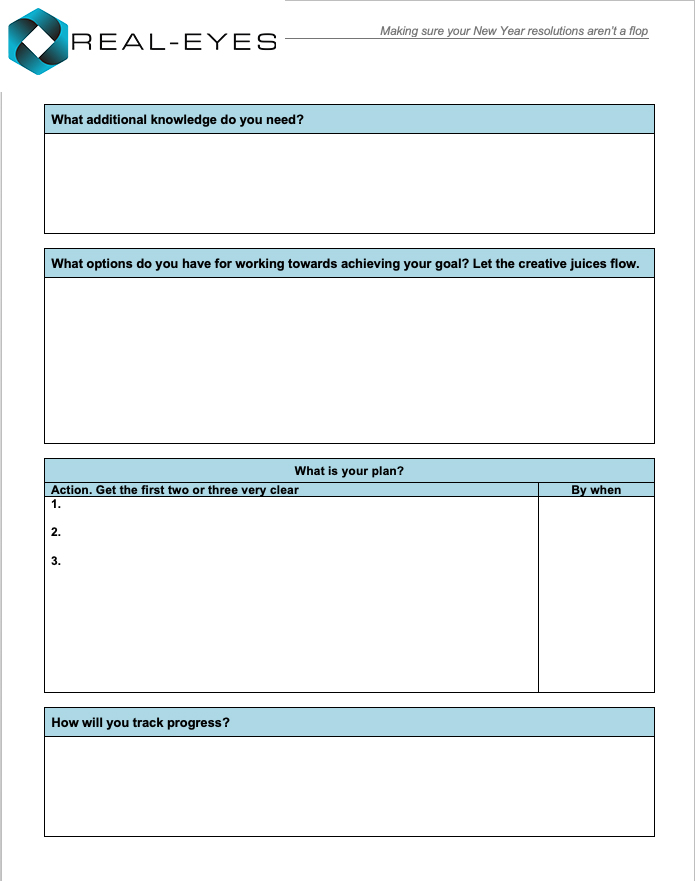
This article is focused on the last point – how you can maximise your chances of giving your New Year’s resolutions some life beyond the end of January. Whilst it reads as a linear process, it is best treated as iterative where you bounce around all the components as your energy and interest takes you. There is a goal planning template at the end of the article.
What do you want?
Ideally your goal is expressed in terms of what you want, as opposed to what you don’t want, for example,
- Developing greater emotional self-control and in particular, better control my anger, as opposed to,
- Avoiding angry outbursts.
Be as clear and precise as possible, including:
- Defining what you want, e.g. to be able to run a half-marathon, or to develop greater emotional self-control and in particular, better control my anger.
- Pinpointing when you want it, e.g. by midway through the year.
- Specifying to what standard. For some goals, such as the half marathon example, quantitative measures, such as, posting a time of one hour 40 or less, are quite appropriate. For other goals, such as, developing better control my anger, qualitative measures are more appropriate. A helpful way to develop these, is to ask the question, what will I be doing and what will others be seeing if I am “better controlling my anger?” Examples might be:
- I have fewer angry outbursts.
- I am better able to spot the signs of frustration and anger building up within me – I know the signs that my fuse is getting short.
- I have tactics that I can deploy to manage myself when I am on a short fuse and I use them.
- I better understand my triggers for getting angry.
- I express my anger in appropriate and conscious ways.
- After I have been angry, I analyse the situation to test whether my anger was appropriate. If it wasn’t, I apologise to the other person(s).
Why do you want it?
- This is a critical question, because when the going gets tough, as it invariably will (if the goal is significant) it is this that will play a big part in keeping you going. The answer to this question is your motivation for changing and for making sacrifices.
- What is achieving this goal going to give you? May be you are sick of being a certain way. Maybe achieving your goal will make you feel a lot better about yourself.
- Imagine you have achieved your goal. What does it feel like? What is different? How are you feeling about yourself? There is hard evidence that demonstrates that this type of imagining or visualisation directly and positively impacts our ability to change.
Where are you now?
- What are the harsh facts about where you are now? For example,
- I run 2-3 miles once per week.
- I am two stone overweight, or
- I have angry outbursts most months.
- How are you feeling and thinking about where you are now? What’s your self-talk about it?
- If you are tackling a long standing habit, in can be useful to ask,
- What have I tried up to now that has worked in some way?
- What have I tried that hasn’t really worked?
- How has all this left me feeling? In the worst case scenario, it may be that you are feeling resigned to the way things are and have little hope that things can change. Acknowledging the way things are, can be a potent starting point for change.
- If you are tackling a long standing aspect of yourself and you want to better understand, why it is difficult to change, the following exercise can be particularly helpful:
- Ask yourself, or have someone else ask you, ‘Why does it make sense to, “have angry outbursts?”
- Ask the question seven or eight times.
- Don’t try to answer it analytically, but rather respond instinctively, relying on your gut sense more than your head.
- You may be surprised and enlightened by the responses. I was when earlier this year I applied it to an issue I have been battling with for a number of years.
- What habits and practices do you have that support the way things are now? For example:
- With the half marathon example, it may be that you are working flat out and do exercise when you have the space and you don’t plan for it.
- With the controlling angry outbursts example, it may be that you are consistently working 60+ hours per week and make virtually no time for self-analysis and reflection.
- What is the cost of not changing?
- To me?
- To those around me?
- To society? This may sound grandiose, but society normally pays a cost for our ills, for example, America pays $160 billion a year on obesity-related medical costs, twice what it paid only a decade ago.
What are the dynamics at work in your environment that could help and hinder you?
Invariably there will be certain forces at play that will both help and hinder you in changing. Understanding what these are and planning to use or manage them can be helpful. These might be things within yourself or things within your environment (resources, relationships), for example in the half-marathon example:
- Forces that could help:
- One of my friends is a runner – I could run with them.
- My employer offers subsidised gym membership and this is within walking distance of the office; It has a running machine.
- Once I go public on a commitment, I know I won’t back out.
- Forces that could hinder:
- My spouse is not very supportive – they see all the training time as even more time away from the family.
- Planning regular training times is difficult because of the irregular and at times unpredictable nature of my work.
What support do you need?
If we are changing something that has some history, we will probably need to enrol other people into helping us. This requires some vulnerability and can be humbling. Generally speaking, however, when an issue that we are working on is out in the open, it tends to feel lighter and has less power than when it is tucked away in our heads only. This might include sharing with a small number of trusted people your goal and plan, why it matters to you and that you recognise you need help. That help may include:
- Asking and authorising people to ask you how you are doing against your plan.
- Keeping them updated on progress.
- Asking for their input into the plan. If they know you well, this can be invaluable.
- Asking them to share with you their perspective on how you are progressing. Change is often slow and when you are grinding away at it, you can easily lose perspective. Having trusted people who are taking that broader perspective and sharing it with you can be invaluable.
What additional knowledge do you need?
There are some issues where we simply do not know enough about the topic to change. I go cycling with a group of mates, and for a while, we had been trying to improve our times and were making little progress. Our tactics had been to cycle more often and to cycle flat out all the time. Frustrated with the lack of progress, one person decides to do something different – they sought out a sports scientist, had a comprehensive fitness test and got professional advice on how to improve. It turned out that our approach of cycling more often and going flat out wasn’t the best approach after all. To develop longer-term capability we needed to be focusing much more on heart rate based training plans with planned recovery afterwards. It also emerged that progressing to the next level of performance was going to require a serious level of commitment. Without that specialist input, we would still be floundering now!
What additional or specialist knowledge do you need? Where can you access it?
What options do you have for working towards achieving your goal?
This is a brainstorm. Let your creative juices flow and free-wheel in generating ideas.
What do the initial steps of the journey look like, what are the phases of the journey that you envisage and what is your plan?
The most critical part of this is deciding on the initial steps and getting started. We may plan the entire journey, but one thing is guaranteed – it won’t turn out exactly how we imagined it – none of us has that much control.
What do the phases of the journey look like? There is often the enthusiastic start, the hard slog in the middle and the relieved and jubilant finish. What are some of the landmarks that indicate you are making progress? In the half marathon example, this would be quite easy to define. It is harder but just as important with less tangible goals.
What is your plan? What will you do and when?
How will you track progress?
- For most people, achieving a goal isn’t a straight line journey. If you are trying to change something that has history, there are likely to be ups and downs along the way. How will you know you are on track? How will you know the progress you are making?
- Having some sort of weekly review fits into the rhythm of most people’s lives and provides:
- A chance to acknowledge progress, and if necessary,
- A short enough time frame to take corrective action before the wheels have seriously come off!
In closing
All of this may sound like a lot of work; you’re right it is! After 20 years of working in the field of personal and organisation change, I have come to realise that changing ourselves and achieving things that matter is virtually always hard work. Coming back to the start of the article and the most depressing day of the year – it is easy to see why most New Year’s resolutions have been broken by the last Monday in January. Hopefully, this article has shown two things:
- You can reduce the chances of that happening by some thorough analysis and planning, and,
- If it does happen, it isn’t a major problem – catch yourself fast, dust yourself down and get back on the horse. Happy riding.
Written by Matthew Gregory (email: matthew.gregory@real-eyespod.co.uk)